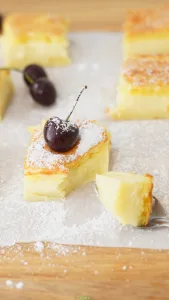
This Magic Three Layer Custard Cake starts with one thin vanilla batter that separates as it bakes into a light sponge top, creamy custard center, and soft base. Whipped egg whites, lukewarm milk, and gentle baking are what give the cake its three distinct textures.
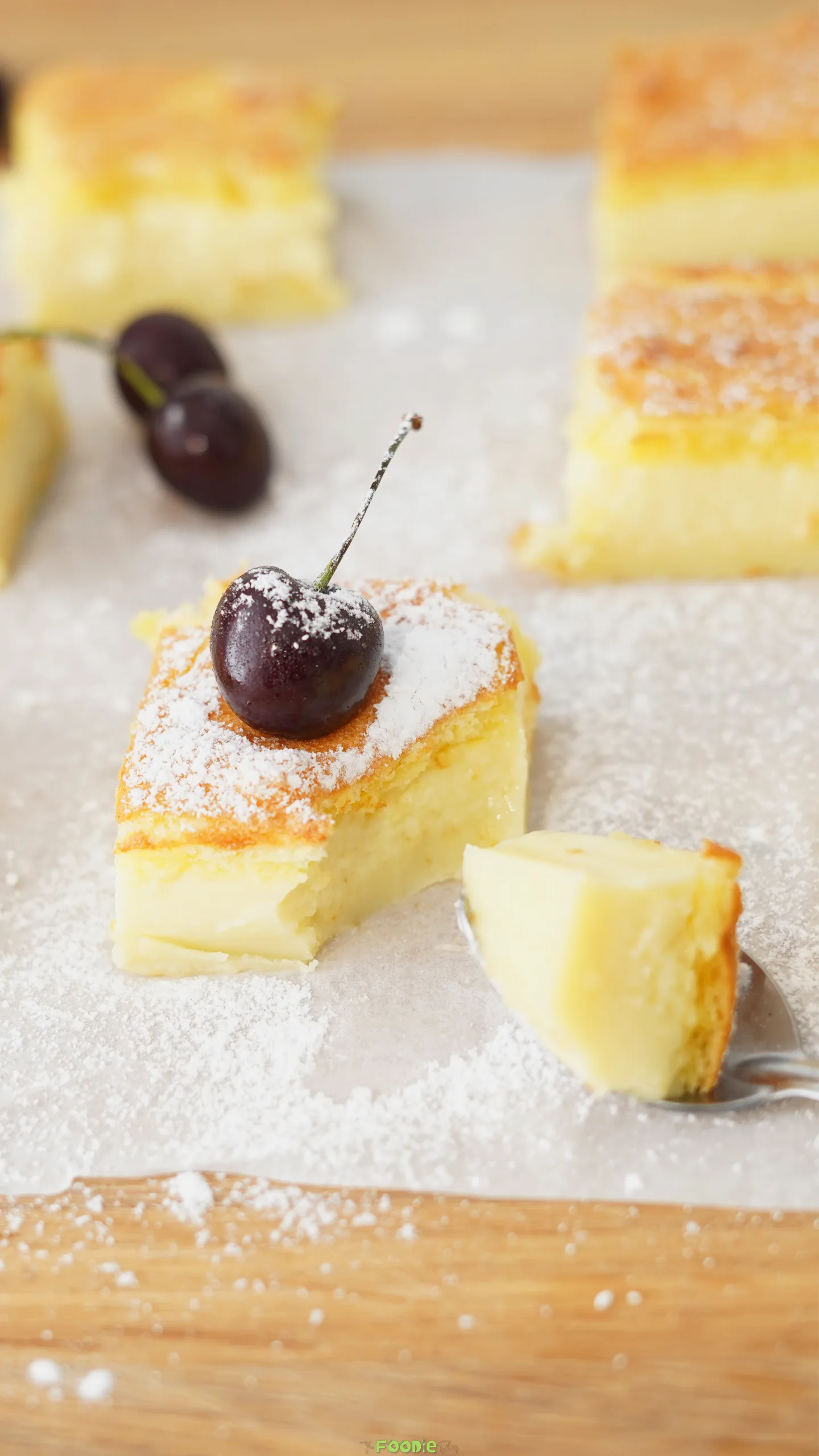
It’s especially good chilled and finished with a light dusting of powdered sugar. If you enjoy creamy baked desserts, try my Easy Flan Recipe, 3-Ingredient Japanese Cheesecake, Vanilla Butter Cake, or Crème Brûlée.
What Is Magic Custard Cake?
Magic custard cake is a vanilla dessert made from a thin egg, milk, butter, and flour batter with whipped egg whites folded in at the end.
While baking, the mixture separates into three textures: a light sponge layer on top, creamy custard in the center, and a firmer tender layer underneath.
Unlike a traditional three-layer cake, these layers are not baked separately and stacked. They form naturally inside one pan.
Table of contents

Ingredients You’ll Need
- 4 large eggs, separated and at room temperature
- 3/4 cup granulated sugar (150 g)
- 1 teaspoon vanilla extract (5 ml)
- 1/2 cup unsalted butter (125 g), melted and slightly cooled
- 3/4 cup all-purpose flour (115 g)
- 2 cups lukewarm milk (500 ml)
Powdered sugar, fresh cherries or berries, and whipped cream are optional toppings. Use an 8-inch square pan for the batch below.
Use room-temperature eggs so the yolks blend smoothly and the whites whip well. Lukewarm milk is also important because cold milk can firm up the melted butter too quickly.

Let’s Make Magic Three Layer Custard Cake
Whip the egg whites and beat the yolks
Preheat the oven to 325°F (160°C). Grease and line an 8-inch square baking pan with parchment paper, leaving some paper hanging over the sides for easy lifting.
Place the egg whites in a clean, dry bowl. Beat with a hand mixer until stiff peaks form, then set aside. The egg whites should look glossy and hold a peak that stands upright when you lift the beaters. Avoid beating beyond this stage, because overbeaten whites can become dry and harder to fold into the batter. See King Arthur Baking’s guide to making meringue for a clear visual explanation of the different stages.
In another large bowl, beat the egg yolks and sugar for about 1 to 2 minutes. The mixture should become pale yellow, creamy, and slightly thicker.

Add butter, vanilla, flour, and milk
Add the melted butter and vanilla to the yolk mixture. Beat until smooth.
Add the flour and mix just until it disappears into the batter. Slowly pour in the lukewarm milk in several additions while mixing on low speed. The batter will become very thin, almost like a thick cream, which is exactly what you want.

Fold in the whipped whites
Add the whipped egg whites in three additions. Use a spatula and fold gently after each addition.
Use a wide spatula and bring the batter up from the bottom of the bowl, then fold it gently over the whites. This keeps more air in the mixture, which helps create the light sponge layer on top. See Joy the Baker’s guide to folding egg whites for the folding technique.
Do not try to mix until completely smooth. A few small lumps or streaks of egg white are normal and help create the lighter sponge layer on top.
Bake until set and golden
Pour the batter into the lined pan. Bake for 40 to 55 minutes, until the top is golden and the center no longer jiggles when you gently move the pan.
Check the cake after 30 minutes. If the top is already golden but the center still moves too much, loosely cover it with foil and continue baking in 10-minute intervals.
Cool in the pan for at least 1 hour. For the cleanest slices and a firmer custard center, refrigerate it for 1 to 2 hours before cutting into squares.


How Do the Three Layers Form?
The batter is much thinner than ordinary cake batter. The folded egg whites provide the airy top, while the milk-and-egg mixture sets into the custard center and denser base. You pour it all into the pan together; there is no separate filling to cook or layer.
Common Mistakes to Avoid
- Adding flour to thicken the batter. It is meant to be very thin after the milk goes in. Keep the quantities as written.
- Using hot butter or cold milk. Cool the melted butter slightly and use lukewarm milk so the mixture stays smooth.
- Beating away the egg-white streaks. Fold in three additions and leave a few small visible pieces rather than making a completely smooth batter.
- Switching to a much larger pan. The 8-inch square pan gives the batter enough depth for the layers.
- Slicing while warm. Allow an hour to cool in the pan, then 1 to 2 hours in the refrigerator before cutting. Plan for this cooling and chilling time as well as mixing and baking.
What to Serve With Magic Custard Cake
Dust the chilled squares with powdered sugar just before serving, and add cherries, berries, or a little whipped cream. Keep the topping light so the vanilla custard remains the main flavor.
If you enjoy creamy desserts with a contrasting top, try my lemon posset brûlée, with its chilled citrus cream and crisp sugar finish.
FAQs
Yes. This dessert is excellent for making ahead because chilling helps the custard layer firm up. Bake it the day before, refrigerate overnight, and dust with powdered sugar before serving.
Keep it covered in the refrigerator for up to 3 to 4 days. The top layer may soften slightly over time, but the flavor remains delicious.
Yes, although fresh is best. Freeze the squares individually with parchment paper between layers, then thaw in the refrigerator before serving.
No. This recipe contains no baking powder or baking soda. Whipped egg whites provide the light sponge layer, so fold them in gently.
The recipe below uses dairy milk. Plant-based milks can change how the custard sets, so there is no tested dairy-free swap listed here.
The most common reasons are overmixing the egg whites, using cold milk, baking at too high a temperature, or removing the cake before it is fully set. Keep the batter thin, fold gently, and bake slowly at 325°F.
The unbaked batter should be thin. After baking, cool the cake in its pan for 1 hour, then refrigerate for 1 to 2 hours before slicing. A liquid center after chilling may mean the cake was underbaked.
Overmixing the egg whites or baking at a temperature that is too high can prevent the layers from separating properly.
Whole milk gives the best results because it creates a richer custard layer. Skim milk can work, but the middle layer may be thinner and less creamy.
More Recipes You’ll Love
Magic Three Layer Custard Cake
Ingredients
Equipment
Method
- Preheat the oven to 325°F (160°C). Grease and line an 8-inch square baking pan with parchment paper.
- Beat the egg whites in a clean bowl until stiff peaks form. Set aside.
- In another bowl, beat the egg yolks and sugar until pale, thick, and creamy.
- Add the melted butter and vanilla. Beat until smooth.
- Add the flour and mix only until combined.
- Slowly add the lukewarm milk while mixing on low speed. The batter will be very thin.
- Fold the whipped egg whites into the batter in three additions. Do not overmix; a few egg white streaks are fine.
- Pour the batter into the prepared baking pan.
- Bake for 40 to 55 minutes, until the top is golden and the center does not jiggle when the pan is moved.
- If the top browns too quickly, cover loosely with foil and continue baking until the center is set.
- Cool in the pan for 1 hour. Refrigerate for 1 to 2 hours before slicing for cleaner squares.
- Dust with powdered sugar and serve with cherries, strawberries, or whipped cream.
Nutrition
Video
Notes
- Use room-temperature eggs for better volume when whipping the whites.
- Lukewarm milk helps the melted butter blend into the batter smoothly.
- The batter should be thin; this is normal.
- Do not use self-rising flour.
- Do not overfold the egg whites.
- The cake is ready when the top is golden and the center no longer jiggles.
- Nutrition is estimated without optional toppings.
Tried this recipe?
Let us know how it was!Estimated reading time: 8 minutes